Autism’s Overlooked Layer: Dyspraxia, Apraxia, and the Hidden Impact on Speech
What looks like delay or behavior may be the brain struggling to plan movement and speech.

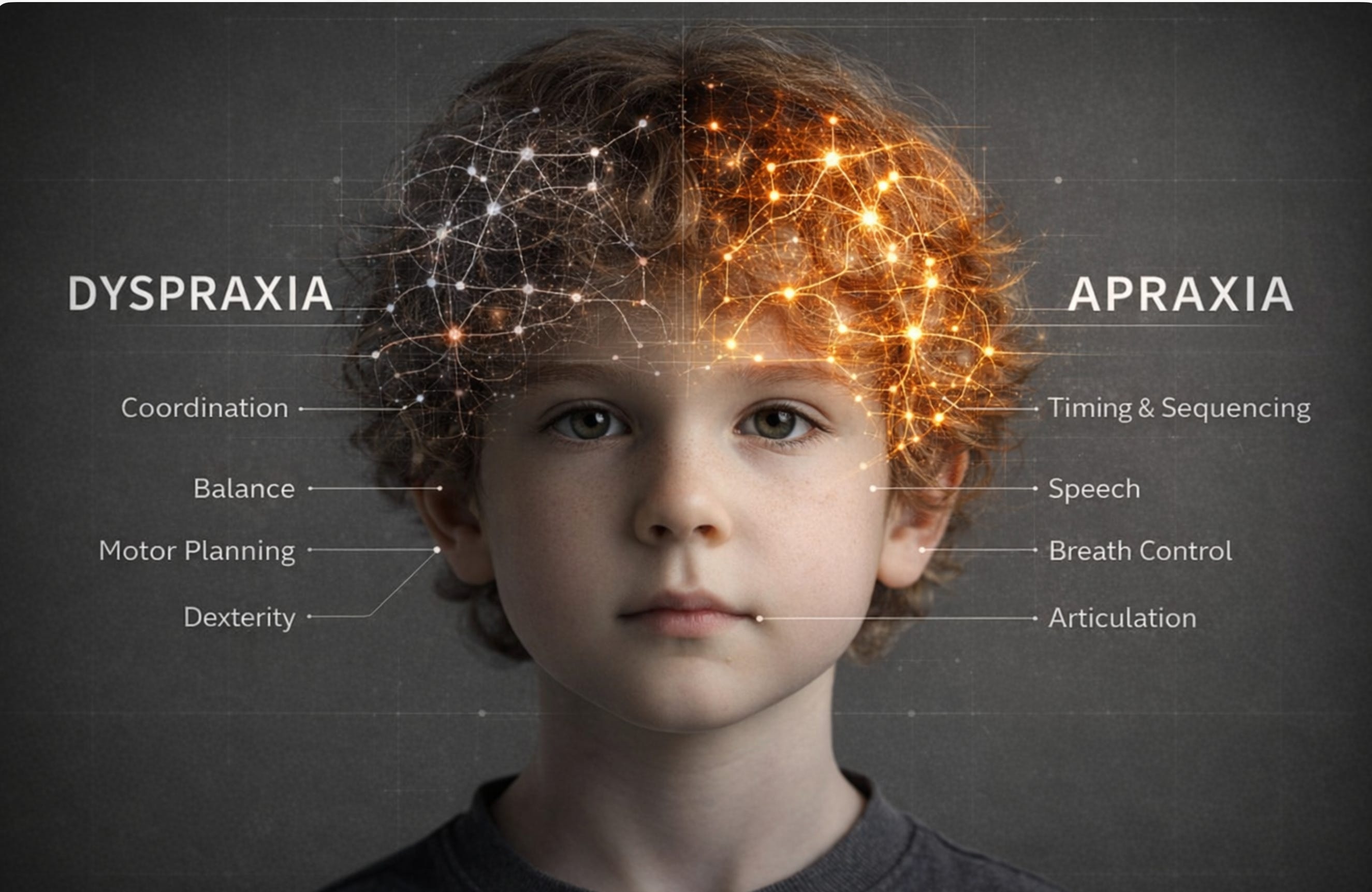
For decades, autism has been framed as a single diagnosis. In practice, it often reflects a broader neurodevelopmental profile with overlapping conditions that shape how a child moves, communicates, and navigates daily life. Among the most common (and frequently underrecognized) are dyspraxia, or developmental coordination disorder (DCD), and apraxia, including childhood apraxia of speech (CAS). Both affect motor planning, but in different ways: dyspraxia impacts whole-body coordination and the ability to carry out sequences of movement, while apraxia—particularly CAS—affects the brain’s ability to plan and produce the precise movements required for speech.
Estimates vary, but a substantial share of autistic children, often cited between 50 and 80 percent, experience motor coordination difficulties consistent with dyspraxia. These challenges can appear early: delays in crawling or walking, difficulty with balance, trouble using utensils or holding a pencil, or struggles sequencing multi-step actions like getting dressed. Apraxia can emerge alongside these differences, particularly when a child has difficulty translating intention into action, even when the desire or idea is clear. Because autism diagnoses are primarily based on social communication and behavior, these motor-planning differences have historically been treated as secondary. In reality, they can be central to how a child experiences both movement and communication.
The connection to speech lies in the same underlying process: motor planning. Speaking is not just cognitive or linguistic—it is a highly coordinated motor task involving precise timing and sequencing of the lips, tongue, jaw, and breath. In children with apraxia of speech, the brain has difficulty planning and coordinating these movements, even when the child knows what they want to say. This can result in inconsistent speech errors, difficulty imitating sounds, disrupted prosody, limited intelligibility, or delayed expressive language. While not all autistic children have apraxia, the overlap is significant enough that clinicians are increasingly evaluating speech differences through a motor-planning lens, rather than attributing them solely to language delay.
Researchers are exploring shared neurological pathways that may help explain these overlaps. Dyspraxia and apraxia are both associated with differences in how the brain integrates sensory input and translates it into coordinated action—processes involving the cerebellum, motor cortex, and parietal regions. There is also growing interest in predictive processing, the brain’s ability to anticipate and prepare for movement. When these systems function differently, tasks that require timing, sequencing, and coordination—whether tying shoes, navigating a staircase, or producing a sentence—can become significantly more effortful.
This has practical implications that extend well beyond the classroom. When motor planning affects both physical actions and speech, everyday routines can become layered challenges. A child may struggle not only to complete a task like showering or brushing teeth, but also to communicate needs, ask for help, or describe what feels difficult. What may be interpreted as noncompliance, delay, or lack of engagement is often a reflection of the brain working harder to organize and execute both movement and language.
Despite this, dyspraxia and apraxia are frequently underdiagnosed within the autistic population. Motor challenges are often folded into the broader autism label, while speech differences may be attributed solely to language delay or behavioral presentation. The result is that families may not be referred to targeted supports such as occupational therapy, physical therapy, or motor-based speech interventions that address the underlying coordination and planning challenges.
The long-term impact is significant. Motor planning differences do not resolve on their own, and when unaddressed, they can affect independence, confidence, and social participation. Communication challenges tied to apraxia can further compound these barriers, limiting access to education, employment, and community life. Yet many systems still separate cognitive, behavioral, and motor supports, rather than recognizing how deeply interconnected they are.
Understanding the relationship between autism, dyspraxia, and apraxia reframes the conversation. It shifts the focus from isolated symptoms to integrated development—recognizing that communication is not just about language, and independence is not just about behavior. Both depend on the brain’s ability to plan, sequence, and execute action.
As research continues to evolve, the question is no longer whether these overlaps exist. It is whether systems will adapt by identifying motor and speech-related differences earlier, expanding access to specialized therapies, and designing supports that reflect the full complexity of how individuals move, speak, and interact with the world.

