Beyond Graduation: The Expanding Push for Adaptive College Pathways in Disability Education
As more students with autism and intellectual disabilities leave high school, a fragmented system of postsecondary options is emerging—offering opportunity for some and exposing gaps for many.

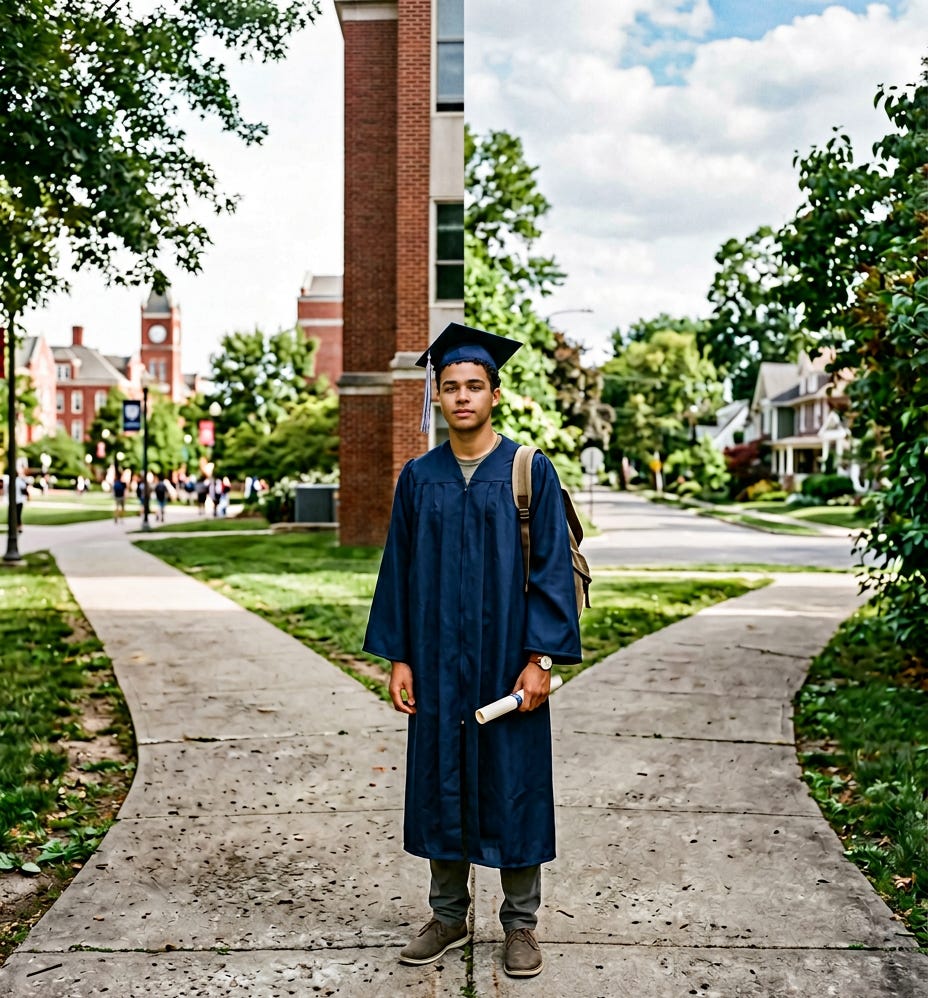
For decades, the national conversation around special education has largely ended at high school graduation, with federal law guaranteeing services through age 21 but offering little structure beyond that point. But across the United States, a growing network of colleges and universities is beginning to redefine what comes next and who gets to participate.
Specialized institutions such as Landmark College and Beacon College have built entire academic models around students with learning disabilities, ADHD, and autism, offering low student-to-faculty ratios, embedded academic coaching, and curriculum pacing designed for neurodiverse learners. At the same time, traditional universities, including Drexel University and Rutgers University, have developed specialized support tracks within larger campus systems, pairing degree programs with executive functioning support, social coaching, and structured advising. Parallel to these efforts, federally recognized Comprehensive Transition Programs (CTPs), authorized under the Higher Education Opportunity Act, have expanded to more than 150 campuses nationwide. These programs are specifically designed for students with intellectual disabilities, including Down syndrome, and allow access to college coursework, campus life, and workforce training even when a traditional degree pathway is not the end goal.
What distinguishes these programs is not simply access, but intentional design. Many incorporate daily or weekly executive functioning coaching, scaffolded schedules, peer mentoring, and sensory-aware environments—acknowledging that success in higher education is not purely academic, but deeply tied to organization, regulation, and predictability. Some programs include modified housing with quieter floors or structured residential supports; others embed vocational internships directly into the academic calendar. At University of Iowa REACH Program, for example, students participate in a two- to four-year certificate program that combines academics, career exploration, and independent living skills. At UCLA Pathway Program, students live on campus and audit courses while receiving targeted life-skills training. These models reflect a broader shift: colleges are beginning to adapt to students, rather than expecting students to conform to systems that were never designed for them.
Yet access to these programs remains uneven and, in many cases, exclusionary. Capacity is limited—many programs accept only a small cohort each year—and geographic distribution is inconsistent, leaving large regions of the country without viable options. Cost is a significant barrier: while some CTPs allow students to access federal financial aid, many programs operate outside traditional funding structures, with annual tuition and support costs that can exceed $20,000 to $40,000, often without full coverage through scholarships or public funding. For families, the result is a fragmented landscape with little centralized guidance, where access to opportunity is frequently determined by awareness, location, and financial resources rather than student need.
The stakes are high. According to data from the U.S. Bureau of Labor Statistics, the employment rate for individuals with disabilities remains significantly lower than for those without disabilities—hovering around 20–25% compared to roughly 65% for the general population. Longitudinal research from the National Longitudinal Transition Study-2 has shown that young adults with intellectual and developmental disabilities experience markedly lower rates of postsecondary education participation, independent living, and sustained employment in the years immediately following high school. Without structured postsecondary pathways, many families describe what is commonly referred to as “the cliff”—a sudden and dramatic loss of services, therapies, and daily structure once entitlement-based K–12 education ends. In that gap, regression is not uncommon, particularly for individuals who rely on routine, skill reinforcement, and supported environments.
Adaptive and inclusive college programs are increasingly viewed not as optional enhancements, but as critical infrastructure bridging education and adulthood. Outcomes data from programs that integrate academic, social, and vocational supports suggest improved employment rates, higher levels of community participation, and greater independence in daily living skills compared to peers who do not access postsecondary supports. The expansion of these programs signals a broader redefinition of educational success. The question is no longer limited to whether a student can graduate, but whether they can navigate a workplace, manage a schedule, build social networks, and sustain some level of independence over time. As demand accelerates, the challenge facing policymakers, institutions, and funding systems is not whether these programs are effective—it is whether they will be scaled equitably, or remain a patchwork of opportunity accessible only to those who know where to look and can afford the path forward.

