Chefs on the Spectrum: Inside the Industry That’s Quietly Getting It Right
Why one of the most demanding industries may be the best blueprint for fixing autism employment
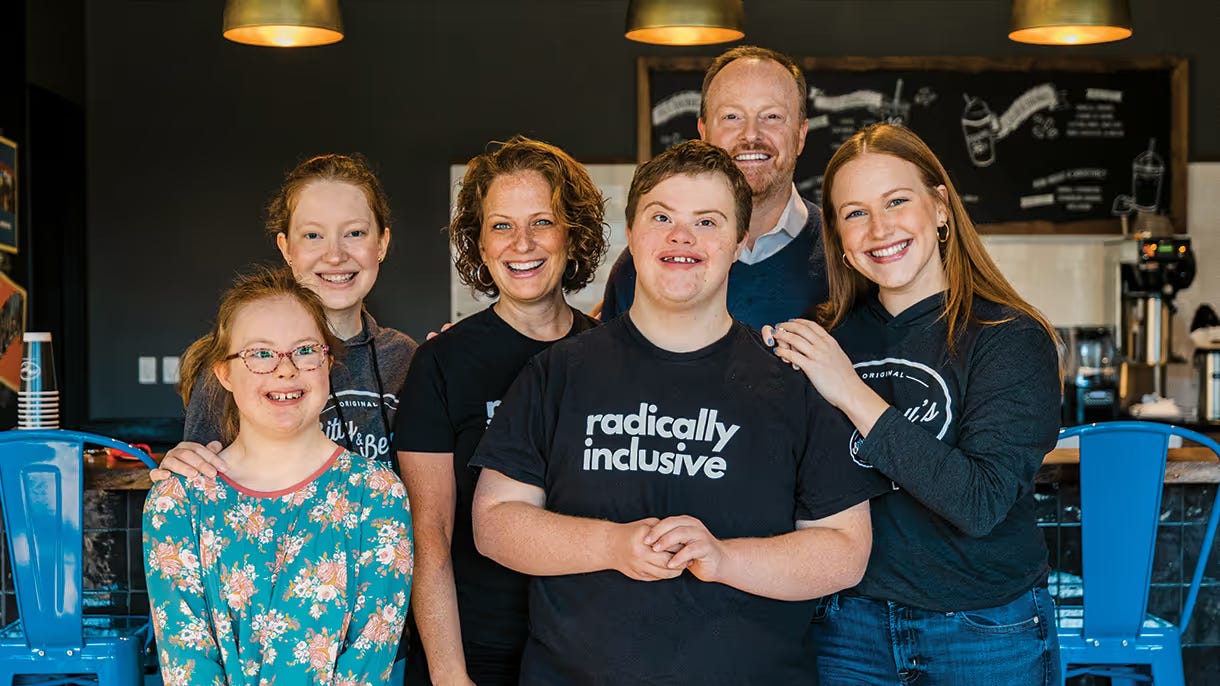
At Bitty & Beau’s Coffee, something different happens behind the counter. Orders are taken with precision. Drinks are made with consistency. Customers are greeted with a level of focus and authenticity that many traditional service environments struggle to replicate. What began as a single café has expanded into a multi-location business built around employing individuals with intellectual and developmental disabilities, including many on the autism spectrum. It’s often framed as a feel-good story. But that framing misses the point.
What’s happening in places like this—and in a growing number of kitchens, bakeries, and culinary training programs—is something more significant: a quiet correction of a long-standing assumption about who belongs in high-performance work environments. Because while the success stories are growing, the data behind them tells a far more complicated, and urgent, story.
Across the United States, employment outcomes for autistic adults remain among the lowest of any population. Even conservative estimates suggest that roughly 40% of autistic adults are unemployed, while broader analyses indicate that as many as 75% to 85% are either unemployed or underemployed. Only about one in four autistic adults is fully employed, and in some studies, as few as 14% hold consistent, paid positions within their communities. This is not a reflection of capability. It is a reflection of systems that were never designed with neurodivergent workers in mind.
And yet, when you look closely at the structure of a professional kitchen, the disconnect becomes harder to ignore. Kitchens are not just chaotic spaces—they are systems. They rely on repetition, precision, timing, and consistency. Tasks must be executed the same way, every time. Deviations are noticeable. Corrections are immediate. In many ways, the environment mirrors the structured, process-driven conditions in which many autistic individuals thrive.
Employers who have recognized this alignment are seeing measurable results. In roles like prep work, baking, line assembly, and inventory management, neurodivergent employees are often described as highly consistent, detail-oriented, and deeply focused on task completion. The outcome isn’t just inclusion, it’s operational reliability. In an industry where consistency defines success, that matters.
But the success of these environments also exposes a deeper problem. Because while the kitchen may be one of the few places where this alignment is obvious, the broader workforce continues to lag behind. Across the disability community as a whole, only about 22 to 24 percent of working-age individuals are employed, compared to roughly 65 to 75 percent of those without disabilities. Autistic individuals consistently fall at the lowest end of that already limited spectrum.
The issue isn’t a lack of preparation. Training programs are expanding. Culinary initiatives, workforce pipelines, and transition programs are equipping autistic young adults with real, applicable skills. In fact, more than half of autistic young adults have worked at some point in their early twenties. But sustained employment—long-term, stable, growth-oriented employment—remains far less common.
That gap has little to do with ability. It has everything to do with infrastructure.
Because transitioning from training into a workplace still depends on variables that are rarely addressed at scale: whether employers understand how to support neurodivergent employees, whether workflows can be adapted without compromising productivity, whether communication is made explicit instead of assumed, and whether someone inside the organization is willing to advocate for a different way of operating. Without those adjustments, the pipeline stalls.
That’s what makes the success of kitchens, and places like Bitty & Beau’s, so important. They are not just creating jobs. They are testing a different model of work. One where clarity replaces ambiguity, where systems replace guesswork, and where consistency is valued as a core strength rather than an incidental outcome. And when those conditions are in place, something shifts—not just for autistic employees, but for the operation as a whole.
Still, these examples remain the exception. For every café or kitchen that gets it right, there are countless workplaces that continue to rely on hiring models built around rapid social interaction, unspoken expectations, and loosely defined roles. Environments where success depends less on skill and more on interpretation. And for many autistic individuals, that is where the breakdown happens.
The rise of chefs on the spectrum is not just a trend. It’s a pressure point. It forces a broader question: if an industry as fast-paced and high-pressure as food service can adapt, and benefit from doing so, what does that say about the industries that haven’t?
There is no shortage of capable individuals. There is a shortage of systems willing to meet them where they are.
And until that changes, the question isn’t whether chefs on the spectrum can succeed. The data already tells us they can. The question is how many more could if the system was built to let them.
Follow Spectrum Dispatch
For reporting on autism, disability, special education, and the systems shaping real life beyond awareness.