It Started With “Timeout Boxes.” Now There’s an Arrest.
What a new criminal case reveals about isolation practices, and the students most at risk
What began as a controversy months ago is now something more serious, and far more urgent.
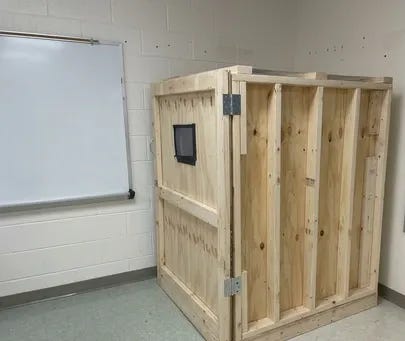
This week, a special education teacher in New York’s Salmon River Central School District was arrested and charged with child endangerment after allegations that she confined a nonverbal student in a dark space and physically mistreated the child. The arrest comes just months after the same district was under intense scrutiny for using wooden “timeout boxes”—windowless, padded structures designed to isolate students, including children with disabilities.
At the time, those images sparked outrage. Parents raised concerns, investigations were launched, and the district ultimately acknowledged the boxes had been used as a disciplinary “timeout” method before being dismantled. Officials promised accountability. State regulators found violations. Leadership changes followed.
But now, with a criminal charge filed in the same district—again involving isolation, again involving a vulnerable student—the story is no longer about what happened then.
It’s about what may still be happening now. And more importantly, how something like this happens at all.
The System That Allows It
To understand this case, you have to understand a term that most parents outside the special education system have never heard: “timeout” or “seclusion.”
In New York, schools are allowed to place students in timeout spaces under very specific conditions. The space must be unlocked, supervised, and used only when there is an imminent risk of serious harm or as part of a documented behavioral plan.
But there’s a critical distinction.
The state bans “seclusion,” generally defined as isolating a child in a locked or inaccessible space. The difference between the two—timeout versus seclusion—is often where things break down.
Because in practice, the line between a “calming space” and a confinement space can become dangerously thin.
A Widespread Practice, Not an Isolated Case
While the images of wooden boxes feel extreme, the underlying practice is not rare. According to state data obtained by the Times Union, more than 3,600 students in New York were restrained or placed in timeout in at least 20,000 incidents in a single school year.
That includes cases where the interventions violated existing regulations.
And while these practices are often justified as safety measures, they disproportionately impact students with disabilities—particularly those who are nonverbal or have complex behavioral needs.
Which raises a difficult reality. The children most likely to be placed in these environments are often the least able to report what is happening inside them.
What Parents Are Actually Saying
In the Salmon River case, the outrage wasn’t just about the boxes themselves, it was about trust. Parents described sudden behavioral changes in their children. Some said their children became more anxious, more resistant to school, or unable to explain what had happened.
One parent said her child, after seeing images of the box, identified it as a place students were sent regardless of whether they were “happy or sad.” Another family reported their child developed a fear of the dark after being confined alone.
These aren’t just discipline strategies. They are experiences that can reshape how a child understands safety.
Now, months later, a teacher has been arrested for allegedly using the same approach and even more egregious actions against special needs students.
The Autism Factor
For children with autism, the stakes are even higher. Many rely on predictable environments, clear communication, and regulated sensory input. Isolation—especially in dark or enclosed spaces—can do the opposite.
It can escalate distress, disrupt regulation, and create lasting anxiety around school environments. And for nonverbal children, the impact can go largely unseen—and unreported.
Where the System Breaks
Cases like this expose a deeper issue that goes beyond one teacher or one district.
Because the question isn’t just “why did this happen?” It’s “what systems allowed it to continue?”
In Salmon River, multiple boxes existed across schools. Parents say concerns went unaddressed. When the issue reached leadership, they claimed limited awareness. And even after regulations were updated in 2023 to tighten rules around restraint and isolation, violations still occurred.
That gap between policy and practice is where harm happens.
The Bigger Question
Timeout spaces, sensory rooms, and de-escalation areas are not inherently harmful. When used appropriately, they can help regulate overwhelmed students, provide a safe space during behavioral crises, and support individualized learning plans. But without strict oversight, proper training, and real transparency, those same tools can become something else entirely. What is intended as support can shift into something less about safety, and more about control.
What This Moment Demands
This story is no longer just about a controversy from months ago. The recent arrest reframes it entirely. Turning what once looked like a contained issue into a broader warning sign.
It raises deeper questions about how schools define safety, how behavior is managed within special education, and who is ultimately responsible when systems fail.
Because when a child cannot speak for themselves, the system is supposed to speak for them.
And when that system breaks down, the consequences do not stay contained within a classroom. They follow that child home—showing up in behavioral changes, increased anxiety, regression, and in families who no longer feel safe sending their children to school.
Final Thought
The language matters.
“Timeout.”
“Calming space.”
“De-escalation.”
These words are meant to signal safety. But for some families, they’re starting to mean something else. And now, with a criminal case attached to what was once described as a disciplinary tool, the question is no longer theoretical:
At what point does a safe space stop being safe?