The Third Factor: What the Cell Danger Response (CDR) Could Mean for Autism
What families should know about the body’s “stuck” stress response and its potential role in autism
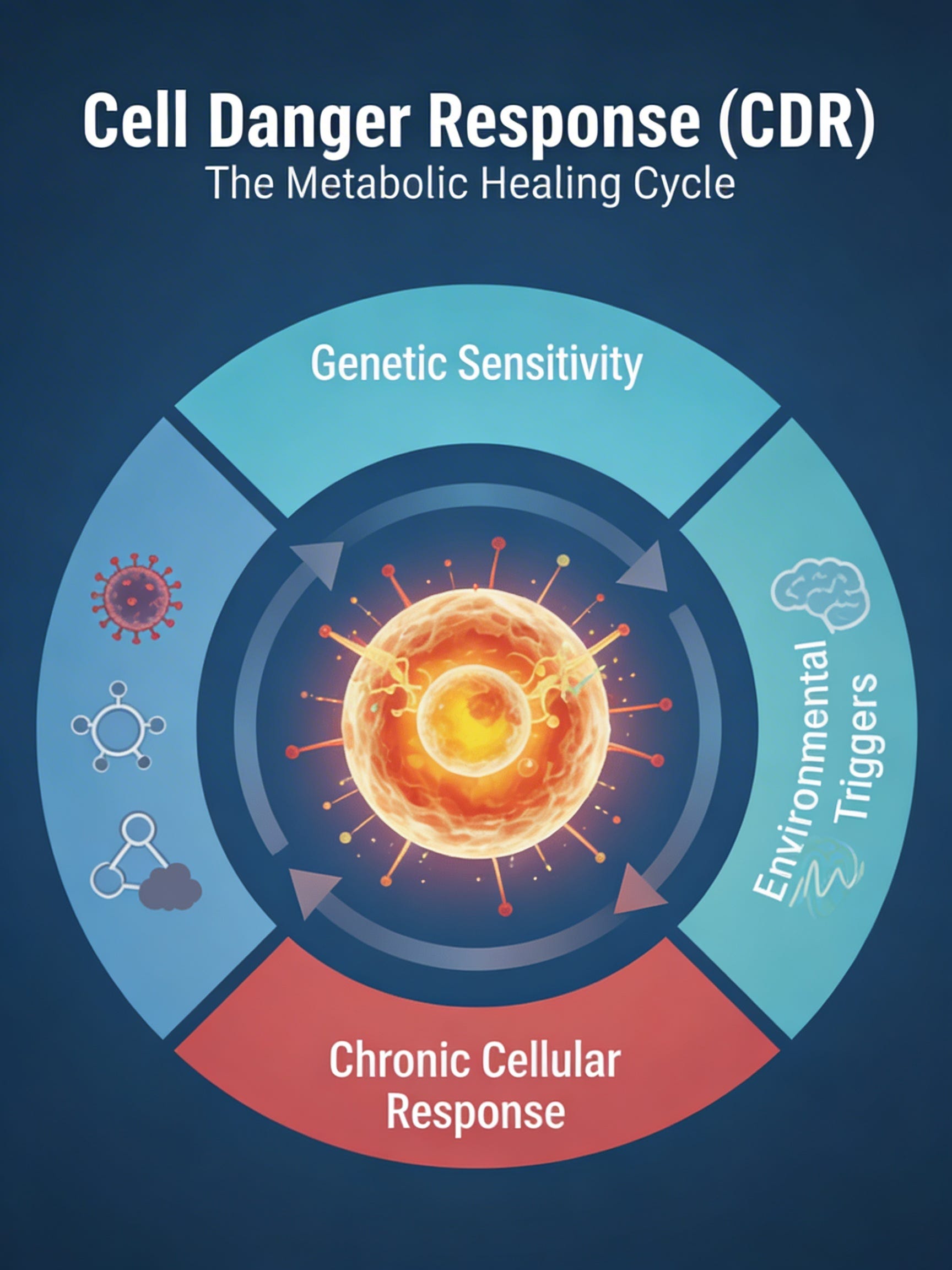
In Friday’s piece, we explored how autism may not be explained by genetics alone. Increasingly, researchers are pointing to a more complex picture—one that includes genetic sensitivity, environmental exposures, and a third factor that operates at the most fundamental level of the body: cellular response. This mechanism is known as the Cell Danger Response (CDR), and it is becoming a central focus in how some scientists understand autism.
At its core, the Cell Danger Response is not a disorder—it’s a survival system. When the body encounters a threat, whether from infection, toxins, or stress, cells shift into a protective mode. They conserve energy, limit communication, and prioritize defense over normal function. This response is essential for healing. As researchers at the University of California San Diego explain, the CDR is a “metabolic process that helps cells heal from injury or infection” and adapt to threats.
Under normal conditions, this process is temporary. The body moves through a sequence—defense, repair, and recovery—before returning to baseline. But the emerging theory suggests that in some children, particularly during early development, this cycle does not fully complete. Instead, the body remains in a prolonged defensive state.
According to Dr. Robert K. Naviaux, this matters because “when it remains activated too long, it diverts the body’s resources from normal growth and development toward cellular defense.”
For a developing brain, that shift can be significant. Early childhood is a period of rapid growth, requiring constant energy, communication between cells, and synchronized development across systems. If the body is instead operating in a low-energy, protective mode, those processes may be disrupted. Researchers believe this could interfere with how brain circuits form, potentially contributing to the core features of autism.
This is where the broader “three-hit” model comes into focus. Rather than a single cause, autism may emerge when three conditions align: a genetic predisposition, an environmental trigger, and a prolonged activation of the Cell Danger Response. The third factor, the persistence of the CDR, may help explain why similar exposures or genetic profiles can lead to very different outcomes across children. As Naviaux explains, autism is not driven by one variable, but by “a series of biological interactions” that shape development over time.
The types of triggers that can activate this response are wide-ranging. Research points to infections, environmental toxins, pollution, maternal immune activation, and even severe stress as potential inputs. These exposures are not unusual on their own, many children encounter them. The difference may lie in how the body responds, and whether it is able to fully reset after the threat has passed.
One of the more important implications of the CDR theory is how it connects different systems in the body. Metabolism, brain function, and the immune system are not operating independently, they are deeply linked. As Naviaux has noted, “metabolism is the language that the brain, gut and immune system use to communicate.” When that communication is disrupted, the effects can appear across multiple systems at once, which may help explain why autism often involves both neurological and gastrointestinal differences.
For families, this research represents a shift. Not toward a single answer, but toward a more integrated understanding. It reframes autism not as something caused by one gene or one moment, but as the result of interactions between biology and environment over time. It also raises new questions about early development, prevention, and whether certain biological processes can be supported before patterns become fixed.
There is also cautious exploration into whether a prolonged Cell Danger Response can be “reset.” Some early-stage studies are looking at how cellular signaling, particularly involving ATP, the body’s energy molecule, might be adjusted to allow the body to exit this defensive state. But this work remains experimental, and it is not yet part of standard medical care.
What the Cell Danger Response offers, more than anything, is a framework. It connects pieces that have long been studied separately—genes, environment, metabolism—and places them into a single, evolving model. It does not replace what we know about autism. But it does expand it.
And for families navigating a system that often looks for simple answers, that shift toward complexity may be exactly where real understanding begins.
Join the conversation.
The science around autism is evolving, and so are the questions. We’re continuing this discussion inside the Spectrum Dispatch chat, where we break down research, share perspectives, and hear directly from families navigating these realities every day.
👉 Join us and be part of the conversation.