Who Gets to Participate? Disability, Democracy and the Barriers Hidden Inside America’s Voting System

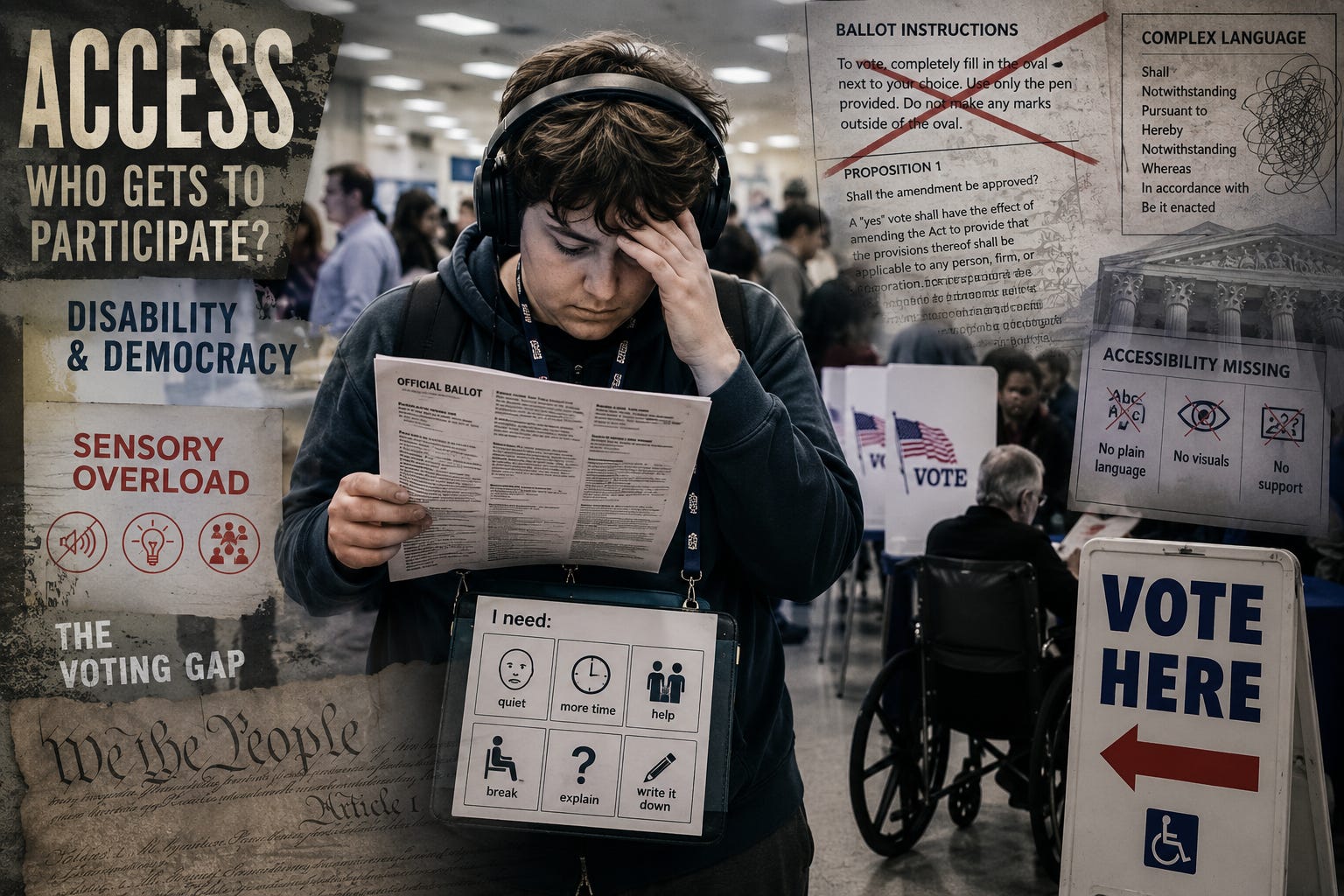
America spends an enormous amount of time arguing about who should not be voting.
Election cycles routinely become consumed with debates over voter rolls, identification requirements, absentee ballots, citizenship verification and election integrity. Politicians argue over fraud, access and turnout. Cable news panels dissect demographics. Social media fills with accusations about who is “informed enough” to participate in democracy.
Far less time is spent asking a different question entirely: whether millions of disabled Americans can meaningfully participate in the process at all.
For many voters with disabilities, the issue is not political ideology. It is navigation. Comprehension. Communication. Sensory tolerance. Transportation. Fatigue. Processing speed. Environmental overwhelm. It is whether the mechanics of democracy were designed with them in mind in the first place.
The Americans with Disabilities Act, signed into law in 1990, transformed large portions of public life. Sidewalk ramps, accessible parking spaces, workplace accommodations and public access requirements became increasingly normalized over the decades that followed. But voting accessibility has often lagged behind other forms of civic inclusion, despite federal protections requiring polling places and election systems to accommodate disabled voters.
Historically, disabled Americans were not only excluded from the mechanics of voting but frequently from the concept of citizenship itself.
Throughout much of U.S. history, people with intellectual and developmental disabilities were institutionalized, segregated or placed under guardianship structures that stripped away legal autonomy. In many states, laws explicitly barred individuals labeled “idiots,” “insane persons” or those deemed mentally incompetent from voting. Some of those restrictions, written in outdated language, still exist in portions of state constitutions today.
Even after broader disability rights movements gained momentum in the 1960s and 1970s, voting access remained inconsistent. The Voting Accessibility for the Elderly and Handicapped Act of 1984 required polling places receiving federal funds to improve accessibility, while the Help America Vote Act of 2002 mandated at least one accessible voting machine in federal elections. But advocates argue that legal compliance and meaningful accessibility are not always the same thing.
For many autistic voters and individuals with intellectual disabilities, accessibility barriers begin long before Election Day.
Ballots are often written in dense legal language. Propositions and referendums can stretch for pages using terminology that even neurotypical voters struggle to interpret. Instructions may rely heavily on long blocks of text with little visual structure or simplified explanation. Polling locations frequently involve fluorescent lighting, crowded environments, loud conversations, shifting lines and unfamiliar procedures — conditions that can quickly become overwhelming for individuals with sensory sensitivities or processing challenges.
The result is that many disabled Americans may technically possess the right to vote while still facing enormous barriers to independently exercising it.
That gap between legal access and functional access is becoming increasingly difficult to ignore as conversations surrounding disability inclusion continue to expand nationally.
In recent years, schools, workplaces and healthcare systems have increasingly adopted visual supports, plain-language communication and sensory-aware practices. Autism awareness campaigns routinely emphasize that many individuals process information visually. AAC devices, communication boards, visual schedules and step-by-step supports have become common tools in educational and therapeutic settings.
Yet many of those same accommodations disappear entirely inside the voting system.
There are few widespread efforts to create visually supported ballots. Plain-language voting guides remain inconsistent by state and county. Poll worker training on developmental disabilities varies dramatically. Sensory-friendly voting initiatives remain rare despite growing public awareness surrounding autism and neurodivergence.
Some local jurisdictions have begun experimenting with more inclusive approaches. Certain counties now offer curbside voting, quieter voting hours, larger print materials or accessible electronic ballot systems. Disability advocacy organizations have also pushed for simplified voter guides and expanded support for voters with cognitive disabilities.
But nationally, the system remains fragmented.
In 2024, disability voting advocates again raised concerns over inaccessible polling sites, broken accessible voting machines, transportation barriers and confusion surrounding absentee voting requirements. According to Rutgers University’s Program for Disability Research, the disability community represents one of the nation’s largest voting blocs, with tens of millions of eligible voters. Yet turnout gaps between disabled and nondisabled voters persist.
Those gaps are not always driven by political disengagement. Often, they are driven by exhaustion.
For some disabled Americans, voting requires extensive planning. Families may need to scout polling locations in advance, identify quieter times to arrive, coordinate caregivers or explain complicated ballot language piece by piece. Others rely on support persons to navigate instructions that were never designed with cognitive accessibility in mind.
And while discussions around election access frequently center on physical disability, cognitive accessibility remains far less understood publicly.
The concept itself can quickly become politically and ethically complicated.
Questions surrounding accessible democracy often trigger fears about oversimplification or concerns about voter competency. Critics may argue that adding visuals, simplified explanations or alternative communication supports risks influencing voters or reducing the seriousness of civic participation.
Disability advocates counter that accessibility is not about changing political outcomes but about ensuring equal opportunity to participate.
They note that visual supports already exist throughout modern society. Airports rely on symbols and icons. Hospitals use color coding and pictorial directions. Schools implement visual schedules. Public transportation systems use universally recognized graphics to help users navigate complicated environments quickly and safely.
Voting, however, remains heavily dependent on dense text, verbal instruction and rapid processing under pressure.
For autistic voters especially, that disconnect can be profound.
Sensory overload inside polling locations may create shutdowns, panic or communication difficulties. Long waits can increase emotional dysregulation. Last-minute procedural changes may create confusion or anxiety. Some voters may avoid participation altogether not because they lack civic interest, but because the process itself becomes inaccessible.
The issue also intersects with broader national conversations about guardianship and autonomy.
In multiple states, adults under certain guardianship arrangements can still face restrictions or confusion regarding voting eligibility. Disability rights groups have increasingly challenged those systems, arguing that intellectual disability should not automatically remove civic participation rights. Supported decision-making models, which allow individuals to receive assistance without surrendering legal autonomy, have gained traction as alternatives.
At its core, the debate forces the country to confront a deeper question about democracy itself.
What does meaningful participation actually look like?
Is accessibility limited to wheelchair ramps and accessible entrances? Or does democracy require systems that people can cognitively navigate, emotionally tolerate and independently understand?
The answers may become increasingly urgent as the disability population grows and autism diagnoses continue rising nationwide.
For years, inclusion conversations largely focused on schools, workplaces and public accommodations. Elections remained comparatively untouched — treated as fixed systems rather than environments capable of adaptation.
But advocates say that may no longer be sustainable.
Because a democracy that prides itself on participation cannot simply measure whether disabled Americans are legally allowed inside the system. It must also confront whether the system was designed for them to successfully move through it in the first place.

